 PH Mundial – Port Harcourt Online Newspaper News across the Niger Delta

Related Articles


By Paul Williams
Environmental pollution as a result of oil spills and the release of hydrocarbons into the environment has for over 50 years plagued the oil-rich Niger Delta region, impacting harshly on the ecosystem and human life and activities.
Worst hit in all of this are the host and other impacted communities in the Niger Delta, some of them in coastal, riverine or upland areas.
Communities, rights activists such as Dr Emem Okon, Executive Director of Kebetkache Women Development and Resource Centre, argue, are directly impacted and therefore should form the first line of response in efforts to remediate and mitigate such environmental disasters.
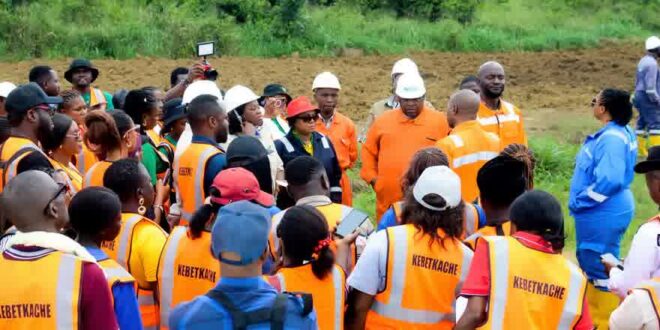
Against this backdrop, Kebetkache Women Development and Resource Centre on Tuesday September 9, 2025 began a two-day training, tagged ‘Capacity Building Training on Community-based Environmental Remediation,’ aimed at building the capacity of communities in the Niger Delta on environmental remediation and mitigation processes.
The training, which held in Port Harcourt, with support from the Ford Foundation, brought together community members from Akwa Ibom, Bayelsa, Rivers, and other states of the Niger Delta.
It included a field trip to Baraliagbo oil spill site in Norkpor Community, Tai Local Government Area, where officials of the National Oil Spill Detection and Response Agency (NOSDRA), who were facilitators at the two-day training, offered practical insight to activities surrounding remediation of a spill.
Executive director of Kebetkache Women Development and Resource Centre, Dr. Emem Okon, said one of the key aims of the training was to explore ways community members can participate in remediation activities.
“We are learning what remediation is and also trying to understand if it is something that community members, most especially women, can engage in.
“We have been advocating for environmental remediation in the Niger Delta. We have campaigned against the pollution. We have campaigned for ecosystem restoration and environmental sustainability. And we also know that women have critical roles to play in protecting the environment.
“This training is part of the process of enhancing what we have been doing, gaining capacity, gaining knowledge, acquiring skills on how to contribute to ecosystem restoration,” she said.
Dr Okon noted that though participants had “spent two days with NOSDRA – yesterday, having the classroom discussion, and today being in the field to observe how it is done.
“These two days is not enough, but it’s just the beginning of a process. So more action and training will come to equip community members further,” she said.
Comrade Henry Eferegbo, from Obelle Community in Emohua Local Government Area of Rivers State, commended Kebetkache for acknowledging communities as first line of defense against environmental degradation.
His community, Obelle, was recently identified by expert studies as one of the high risk areas in the region, with some wells for drinking water in the community identified as containing huge quantities of crude oil.
Eferegbo said “I’m very happy that Kebekache Women Development Resources is setting the pace. It’s not about advocating and screaming that our lands have been polluted. It’s all about also knowing what it takes to clean up the environment.
“I will request that communities should get into this kind of activity that Kebekache has started by actually setting up their indigenees, especially women, to understand the rudiments in cleanup processes.
“Because it will come to the point where communities and individuals can begin to practice, especially when the spill is not much,” he said.
Eferegbo lamented that oil multi-nationals “had polluted the environment”, and sold to a new companies, such as Renaissance, and left.
“Just like ExxonMobil, Agip, and the likes, have not told the community, the new company, but did not tell the community what they ought to do to clean up the place immediately. And if you leave this pollution, it will impact the health of the people.
“So it seems that we should do what we can easily carry out to ensure that the environment is restored, especially when the pollution is not much. We can actually till our environment and replicate what Kebetkache has taught us, if the spill is not much, to ensure that we restore our environment.
“If we don’t restore our environment, nobody else will do it for us. In as much as we encourage government or the regulators to mandate these companies to do what is necessary, we should also play a part to see that our environment is restored, as community people,” he said.
Glory Alexander Thomas, from Ibeno Community in Akwa Ibom State, an oil host community plagued by air pollution from gas flares.
She said, “One of the things I have learnt in the course of this training is that every farmer is a remediator.
“So, going back as a community leader, one of the things that I’m going to really advocate for, especially among the local community women, is to let them know that you as a woman, as long as you are a farmer, you can start the process of remediating your land.
“You don’t wait for any kind of agency or government agency to come and help you. You start the process yourself. As long as you are a farmer, you can do it,” she said.