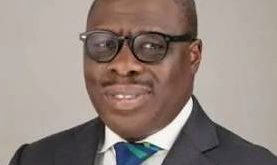
Prof Roseline Konya

Rivers Sets Up Technical Committee on Soot

By Joel Anekwe

In a move to finally resolve the challenge of hazardous soot in the state, the Rivers State Government has set up a technical committee to implement the recommendations of the scientific committee established to investigate the prevalence of soot in parts of the state.

Briefing journalists after the weekly state executive council meeting, commissioner for Environment, Prof Roseline Konya said the state government arrived at the decision after a detailed consideration of the report of the scientific committee.

She said: “The State Executive Council went ahead and appointed members of the Technical committee for purpose of the implementation of the report of the scientific committee.

“The technical committee is to be chaired by the Honorable Commissioner for Environment and other members are as follows, Prof Precious Edeh, Dr. Golden Ohana, the Honorable Attorney General and commissioner for Justice, Commissioner of Water resources. Others are representatives of the IOCs, one each from Shell, Agip, Total, Petro-chemical, Port Harcourt refineries and NLNG.

“There will also be a representative of civil society, as well as Engineer Juliet Ohunna, while the secretary of the committee will be nominated by the ministry of Environment,” she said.

The commissioner said that the scientific committee discovered 12 sources of soot. She said that the technical committee will work towards addressing the sources of soot.

“The sources of soot  are:  refineries, fertilizer companies, illegal  refineries, setting ablaze of illegally refined petroleum products by the military,  tyre burning, gas flaring, meat roasting  with used tyres, asphalt plants refuse burning among others,” she said.

Prof Konya said that the Rivers State Government had written  to the Federal Government  to work with the state to tackle aspects that fall within the purview of federal agencies.

Also speaking, Commissioner of Information, Emma Okah said that the issue of soot is topical and the Wike administration is committed to resolving it.

He said that the technical committee would be inaugurated by the state governor at the commencement of his second term.

He noted that the state government will continue to work for the improvement of the environment.
Share Post on

Check Also

Make Methane Reduction a Business Priority, NLNG’s Falade urges Gas Industry

... Says Monetisation Initiative Cut Nigeria’s Gas Flaring from 65% to 20%  By Paul Williams   NLNG has urged the global gas industry to make methane reduction a business priority, adding that every tonne of methane released into the atmosphere represents lost revenue and gas that could otherwise reach the market.  The company said its experience shows that investment in reducing these losses can pay for itself while cutting emissions and improving plant efficiency.  Managing Director and Chief Executive Officer of NLNG, Mr Adeleye Falade, made the call at Gastech 2026 Exhibition and Conference in Bangkok during a panel titled “Capturing the Lost Opportunity: Driving Global Alignment on Methane Abatement Across Natural Gas Supply Chains.”  He said the NLNG approach starts with measuring methane losses and using the findings to guide investment in leak prevention and gas recovery, with independent verification to ensure credible reporting.  Falade said the industry needed to shift the conversation from the cost of methane reduction to the value it creates, recognising that preventing gas losses serves both commercial and environmental objectives.  “Every tonne emitted is lost product, lost revenue and lost energy; gas we could have sold. Every molecule of methane avoided is both an emissions reduction and a recovered energy resource,” he said.  He cited NLNG’s new boil-off gas compressor and start-up gas recovery project as examples of investments that support this approach. Each project targets methane reductions of approximately 10–15 per cent, and both have positive projected net present values, meaning their anticipated financial benefits exceed their costs over the life of the projects.  Falade said, “The most compelling business case is the simplest one: the projects that cut our methane also pay for themselves. The same discipline that reduces methane also improves asset reliability and plant efficiency. The returns show up in more places than the emissions ledger.”  He explained that credible measurement underpins NLNG’s investment decisions, which allows the company to identify methane losses, direct resources to the right interventions and assess the results.  He noted that NLNG’s experience demonstrates that gas producers in developing economies can establish globally trusted emissions-reporting systems by investing in monitoring infrastructure, building reporting capabilities and submitting their data to independent scrutiny.  Falade highlighted NLNG’s Gold Standard recognition under the Oil and Gas Methane Partnership (OGMP) 2.0 and said the company was the first in Africa to achieve Level 5 methane emissions reporting.  He added that its measurement, reporting and verification (MRV) system is independently assured by DNV in accordance with ISO 14064.  NLNG’s approach includes site-wide optical gas imaging, a structured Leak Detection and Repair programme, and the phased deployment of continuous monitoring and real-time dashboards across its plant and vessels.  …

Leave a Reply

Your email address will not be published. Required fields are marked *