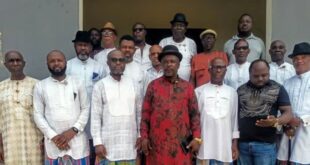
Senator Lawrence Ewhrudjakpo

Job Creation: Bayelsa To Partner NACETEM on Training, Certification of Welders

The Bayelsa State Government has indicated its preparedness to collaborate with the National Centre for Technology Management (NACETEM) for the training and certification of local welders to make them employable in the oil and marine sectors of the economy.

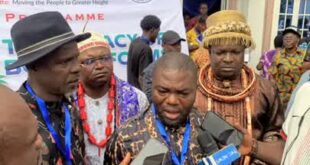
The state Deputy Governor, Senator Lawrence Ewhrudjakpo, gave the indication on Thursday during a courtesy visit by the Director General and other top officials of the federal agency in Government House, Yenagoa.

In a statement by his Senior Special Assistant on Media, Mr Doubara Atasi, the Deputy Governor, maintained that Bayelsa was ready to do everything necessary for the collaboration to work in line with the Diri-led Administration’s agenda for job and wealth creation in the state.

Senator Ewhrudjakpo, however, enjoined NACETEM to also extend its collaborative network to the Niger Delta Development Commission (NDDC), the Nigerian Content Development and Monitoring Board (NCDMB) and other relevant federal agencies on the project.

Underscoring the seriousness the state government attached to the project, he assured the delegation that a crack team would be set up expeditiously to work in synergy with NACETEM officials to facilitate the smooth and timely take-off of the training project in the state.

While decrying certain environmentally unfriendly activities of oil companies in the Niger Delta, Senator Ewhrudjakpo noted that the NACETEM should also engage the companies in its drive to change the narrative in marine mining in the mangrove belt of the country.

Earlier in his remarks, the Director General of the National Centre for Technology Management (NACETEM), Dr. Olushola Odusanya, said they were in the state to seek collaboration with the Bayelsa State Government on the training project for welders.

According to Dr. Olushola, Bayelsa is among seven states in the country earmarked for the NACETEM training programme aimed at filling up the huge shortage of certified and employable indigenous welders in the Nigerian oil and gas industry.

The Director General, who pointed out that the average annual income of a certified welder in the industry was over $40,000, stressed the need for effective cooperation between the state and interventionist agencies of government in the Niger Delta region to train welders up to the level of international certification.
Share Post on

Check Also

Disu Proposes Police Desk to Protect Intellectual Property, Creative Economy 

By Paul Williams  Inspector-General of Police, Olatunji Rilwan Disu, has proposed the establishment of an Orange Economy Security and Intellectual Property Coordination Desk within an appropriate existing structure of the Nigeria Police Force.  He made the proposal on Wednesday, September 16, 2026, while delivering a lecture to participants of Senior Executive Course 48, 2026, at the National Institute for Policy and Strategic Studies (NIPSS), Kuru, Plateau State.  The lecture, titled “The Orange Economy and Entrepreneurship for Sustainable Development in Nigeria: The Role of the Nigeria Police Force,” examined the relationship between security, entrepreneurship and the growth of Nigeria’s creative industries.  It emphasised the role of law enforcement in protecting intellectual property, businesses, digital platforms and other assets that support the sector.  Disu noted that film, music, fashion, publishing, advertising, digital content, gaming, tourism, heritage and the arts are increasingly driven by entrepreneurship, technology and intellectual property.  He stressed that these industries can make a stronger contribution to employment, investment and national development when creators, businesses and their intellectual assets are adequately protected.  The IGP, as part of measures to strengthen the Force’s response to crimes affecting the sector, proposed that the envisaged coordination desk should support specialised policing, inter-agency collaboration, dedicated reporting mechanisms and improved engagement with relevant stakeholders.  He further advocated an intelligence-led and partnership-based approach to tackling organised piracy, counterfeiting, cyber-enabled fraud and other criminal activities affecting creative enterprise.  Disu also emphasised the importance of financial investigation, where applicable, in tracing proceeds linked to criminal networks operating through payment accounts, digital wallets, advertising revenues, logistics networks and online distribution channels.  He called for stronger collaboration between the Nigeria Police Force, the Nigerian Copyright Commission and other relevant institutions on intellectual property protection.  He also identified the protection of film locations, concerts, festivals, tourism sites and cultural assets; improved cybercrime response; preservation of digital evidence; and sustained engagement with creative communities as key areas requiring greater attention.  The IGP highlighted the preventive value of legitimate economic opportunities, noting that providing young Nigerians with credible pathways from talent to lawful income and employment can help reduce vulnerability to criminal activity.  He stressed that piracy, fraud, extortion and other forms of criminality can weaken businesses, discourage investment and undermine innovation.  Disu further stressed that effective policing of the sector must protect both public safety and the rights required for creativity and enterprise to thrive, noting that professional, accountable and rights-respecting policing is essential to building confidence among creators, entrepreneurs and investors.  …

Leave a Reply

Your email address will not be published. Required fields are marked *