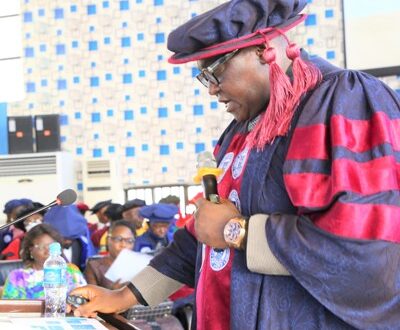
IAUE’s acting vice-chancellor, Professor Okechuku Onuchuku, delivering an address at the institution’s matriculation ceremony on Saturday

IAUE Gets Full-fledged Faculty of Agriculture

By Tunde Uchegbuo

A full-fledged Faculty of Agriculture has been established at the Ignatius Ajuru University of Education, and will commence the admission of pioneer students soon.

Until now, Agriculture was a department in the faculty of Vocational and Technical Education at the institution.

This was made known by the acting vice-chancellor, Professor Okechuku Onuchuku, at the institution’s matriculation ceremony on Saturday, April 23.

6,058 freshmen and women, out of 14,207 candidates that applied for admission, took the matriculation oath.

Onuchuku congratulated the fresh students for transiting from mere candidates to becoming bona fide students of the university and reminded them that their mainstay in the institution is to focus on their studies.

He warned them to shun all manner of social vices and obey the university rules and regulations, emphasising that examination malpractice is a serious crime, and those caught in it or other vices would face an unbendable university management and security agencies.

Onuchuku, who commended parents and guardians for their efforts in the academic career choices of their children and wards, tasked them not to relent, but to continue to support them by paying all school charges promptly so as to enable management sustain the quality education offered at the institution.

The vice-chancellor further advised parents to regularly monitor the academic and social activities of their wards, as he solicited their support towards management’s strive to maintain adequate security on the university campuses.

He also appealed to parents to support the institution in its quest for a conducive learning environment by endowing professorial chairs, donating buildings, or establishing other legacy projects that could be named after them, or any person of their choice.

In a brief profile of the institution, he informed the audience that Ignatius Ajuru University of Education was established out of the former Rivers State College of Education by the University of Education Law, No. 8 of 2009.

The vice-chancellor further assured parents that the university is committed to the pursuit of high impact research, teaching, and community service.

Onuchuku likewise expressed gratitude to the governor of Rivers State and visitor to the university, Chief Nyesom Wike, for the “massive infrastructural development in the educational sector in the state.”

Share Post on

Check Also

Make Methane Reduction a Business Priority, NLNG’s Falade urges Gas Industry

... Says Monetisation Initiative Cut Nigeria’s Gas Flaring from 65% to 20%  By Paul Williams   NLNG has urged the global gas industry to make methane reduction a business priority, adding that every tonne of methane released into the atmosphere represents lost revenue and gas that could otherwise reach the market.  The company said its experience shows that investment in reducing these losses can pay for itself while cutting emissions and improving plant efficiency.  Managing Director and Chief Executive Officer of NLNG, Mr Adeleye Falade, made the call at Gastech 2026 Exhibition and Conference in Bangkok during a panel titled “Capturing the Lost Opportunity: Driving Global Alignment on Methane Abatement Across Natural Gas Supply Chains.”  He said the NLNG approach starts with measuring methane losses and using the findings to guide investment in leak prevention and gas recovery, with independent verification to ensure credible reporting.  Falade said the industry needed to shift the conversation from the cost of methane reduction to the value it creates, recognising that preventing gas losses serves both commercial and environmental objectives.  “Every tonne emitted is lost product, lost revenue and lost energy; gas we could have sold. Every molecule of methane avoided is both an emissions reduction and a recovered energy resource,” he said.  He cited NLNG’s new boil-off gas compressor and start-up gas recovery project as examples of investments that support this approach. Each project targets methane reductions of approximately 10–15 per cent, and both have positive projected net present values, meaning their anticipated financial benefits exceed their costs over the life of the projects.  Falade said, “The most compelling business case is the simplest one: the projects that cut our methane also pay for themselves. The same discipline that reduces methane also improves asset reliability and plant efficiency. The returns show up in more places than the emissions ledger.”  He explained that credible measurement underpins NLNG’s investment decisions, which allows the company to identify methane losses, direct resources to the right interventions and assess the results.  He noted that NLNG’s experience demonstrates that gas producers in developing economies can establish globally trusted emissions-reporting systems by investing in monitoring infrastructure, building reporting capabilities and submitting their data to independent scrutiny.  Falade highlighted NLNG’s Gold Standard recognition under the Oil and Gas Methane Partnership (OGMP) 2.0 and said the company was the first in Africa to achieve Level 5 methane emissions reporting.  He added that its measurement, reporting and verification (MRV) system is independently assured by DNV in accordance with ISO 14064.  NLNG’s approach includes site-wide optical gas imaging, a structured Leak Detection and Repair programme, and the phased deployment of continuous monitoring and real-time dashboards across its plant and vessels.  …

Leave a Reply

Your email address will not be published. Required fields are marked *