Amgbare Urges ‘Joint Effort’ at Improving Living Standard of Niger Delta People


By Amos Odhe

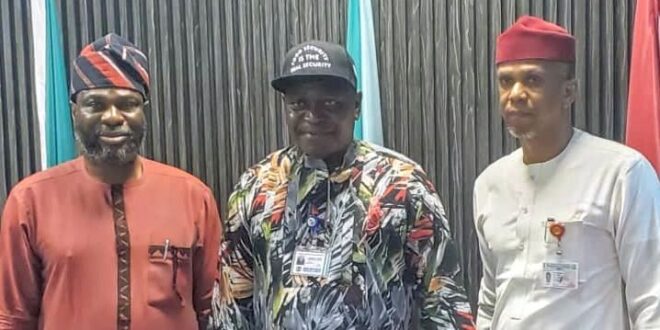
As part of efforts to fasten the development of the Niger Delta Region, the Managing Director and Chief Executive Officer of the Niger Delta Basin Development Authority (NDBDA), Prince Ebitimi Amgbare, has paid a visit to the senators representing the agency’s two catchment areas in Delta State.

The senators, Senator Ede Dafinone (Delta Central Senatorial District) and Senator Joel Onowakpo Thomas (Delta South), represent 18 local government areas of the Authority’s mandate area.

Prince Amgbare during the visit, which took place in Abuja solicited for support from the duo to actualise the mandate of the Authority, aimed at improving the living standard of people within its catchment areas.

“I am here to solicit your support, to improve the living standards of our people within the catchment area. We solicit your support, to help us actualise our mandate,” he said. .

During the discussions, which centered around the critical need to alleviate and elevate the livelihoods of the indigenes in the Niger Delta area, Prince Amgbare emphasized the importance of strategic collaboration between the NDBDA and the senators to address these concerns effectively.

He lamented that the Niger Delta, known for its vast natural resources and significant contributions to Nigeria’s economy, faces numerous challenges, including environmental degradation, unemployment, and underdevelopment.

Highlighting several key areas where immediate intervention could significantly impact the lives of the indigenes, the NDBDA boss listed environmental restoration and protection, agricultural development, infrastructure improvement, youth empowerment and skill development, and community involvement in decision-making processes to ensure that projects are tailored to their specific needs and have long-term sustainability.

The Niger Delta, he said, has suffered extensive environmental damage due to oil exploration and other industrial activities, and proposed joint effort to clean up polluted areas, restore ecosystems and implement sustainable environmental practices.

He noted that with collaborative efforts on the above areas, “there is hope for a better future for the indigenes of Delta South and Central, ultimately leading to a more prosperous Niger Delta region.”

Responding , the two senators expressed their commitment to working closely with the NDBDA and other stakeholders to implement these initiatives.

They acknowledged the vital role of the Niger Delta in the national economy and the need to prioritize the welfare of its people.

Share Post on

Check Also

Make Methane Reduction a Business Priority, NLNG’s Falade urges Gas Industry

... Says Monetisation Initiative Cut Nigeria’s Gas Flaring from 65% to 20%  By Paul Williams   NLNG has urged the global gas industry to make methane reduction a business priority, adding that every tonne of methane released into the atmosphere represents lost revenue and gas that could otherwise reach the market.  The company said its experience shows that investment in reducing these losses can pay for itself while cutting emissions and improving plant efficiency.  Managing Director and Chief Executive Officer of NLNG, Mr Adeleye Falade, made the call at Gastech 2026 Exhibition and Conference in Bangkok during a panel titled “Capturing the Lost Opportunity: Driving Global Alignment on Methane Abatement Across Natural Gas Supply Chains.”  He said the NLNG approach starts with measuring methane losses and using the findings to guide investment in leak prevention and gas recovery, with independent verification to ensure credible reporting.  Falade said the industry needed to shift the conversation from the cost of methane reduction to the value it creates, recognising that preventing gas losses serves both commercial and environmental objectives.  “Every tonne emitted is lost product, lost revenue and lost energy; gas we could have sold. Every molecule of methane avoided is both an emissions reduction and a recovered energy resource,” he said.  He cited NLNG’s new boil-off gas compressor and start-up gas recovery project as examples of investments that support this approach. Each project targets methane reductions of approximately 10–15 per cent, and both have positive projected net present values, meaning their anticipated financial benefits exceed their costs over the life of the projects.  Falade said, “The most compelling business case is the simplest one: the projects that cut our methane also pay for themselves. The same discipline that reduces methane also improves asset reliability and plant efficiency. The returns show up in more places than the emissions ledger.”  He explained that credible measurement underpins NLNG’s investment decisions, which allows the company to identify methane losses, direct resources to the right interventions and assess the results.  He noted that NLNG’s experience demonstrates that gas producers in developing economies can establish globally trusted emissions-reporting systems by investing in monitoring infrastructure, building reporting capabilities and submitting their data to independent scrutiny.  Falade highlighted NLNG’s Gold Standard recognition under the Oil and Gas Methane Partnership (OGMP) 2.0 and said the company was the first in Africa to achieve Level 5 methane emissions reporting.  He added that its measurement, reporting and verification (MRV) system is independently assured by DNV in accordance with ISO 14064.  NLNG’s approach includes site-wide optical gas imaging, a structured Leak Detection and Repair programme, and the phased deployment of continuous monitoring and real-time dashboards across its plant and vessels.  …

Leave a Reply

Your email address will not be published. Required fields are marked *