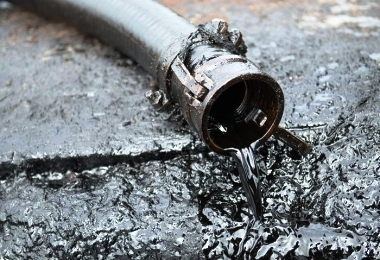
Natural Justice Condemns ‘Persistent’ Oil Spills in Bodo, Seeks Rerouting of Trans Niger Pipeline

Natural Justice Nigeria, the Nigerian arm of the Pan African Civil Society Group, has expressed concerned over what it described as “the repeated and persistent oil spills along the Trans Niger pipeline, particularly the section that bifurcates Bodo community, in Gokana Local Government Area.”

In a release signed by its Community Environmental Legal officer, Lawrence Barinem Dube, the organization said “Bodo, as the last community on the 180,000 BPD trans-Niger Pipeline is sitting on a hydrocarbon time bomb as a result of the failure of Shell to address the long overdue integrity, human security and environmental safety issues on the Trans-Niger Pipeline.

“Natural Justice calls on Shell and the Nigerian Government to immediately remove the oil and the gas pipelines laid in the middle of the community that transports crude oil and gas to the Bonny export terminal and other gas utilization projects,” Dube said.

Natural Justice also called on the National Oil Spills Detection and Response Agency (NOSDRA) “to ensure that the Joint Investigation Visit (JIV) is transparent, peaceful, inclusive of all community stakeholders and line with regulatory standards,” while demanding that Shell cleans up the spills and undertake proper rehabilitation of residents whose homes and farmlands are affected by the spills.

“The persistent spills from this pipeline clearly shows that this is an environmental tragedy unfolding in instalments. Laying crude oil and gas pipelines in the middle of a densely populated community will one day lead to a humanitarian disaster if these pipelines are not removed now!

“Shell’s planned divestment of their onshore assets makes this call even more urgent. The buyers of these assets who have been handpicked by Shell will certainly neither have the technical capacity, experience nor financial standing to manage pipelines that have suffered serious and continuing under – investment and disrepair over the last five decades. They will also not be willing to take responsibility for the environmental liabilities associated with these assets,” Dube said.

Damian Gbogbara, one of the community environmental justice defenders trained by Natural Justice, explained that the spill was noticed on July 4, 2024.

He said the community is exasperated by the continuing spillages, adding that they “demand a permanent solution to the incessant oil spills from this pipeline in our community, we deserve to have an environment that supports life.”

Share Post on

Check Also

Make Methane Reduction a Business Priority, NLNG’s Falade urges Gas Industry

... Says Monetisation Initiative Cut Nigeria’s Gas Flaring from 65% to 20%  By Paul Williams   NLNG has urged the global gas industry to make methane reduction a business priority, adding that every tonne of methane released into the atmosphere represents lost revenue and gas that could otherwise reach the market.  The company said its experience shows that investment in reducing these losses can pay for itself while cutting emissions and improving plant efficiency.  Managing Director and Chief Executive Officer of NLNG, Mr Adeleye Falade, made the call at Gastech 2026 Exhibition and Conference in Bangkok during a panel titled “Capturing the Lost Opportunity: Driving Global Alignment on Methane Abatement Across Natural Gas Supply Chains.”  He said the NLNG approach starts with measuring methane losses and using the findings to guide investment in leak prevention and gas recovery, with independent verification to ensure credible reporting.  Falade said the industry needed to shift the conversation from the cost of methane reduction to the value it creates, recognising that preventing gas losses serves both commercial and environmental objectives.  “Every tonne emitted is lost product, lost revenue and lost energy; gas we could have sold. Every molecule of methane avoided is both an emissions reduction and a recovered energy resource,” he said.  He cited NLNG’s new boil-off gas compressor and start-up gas recovery project as examples of investments that support this approach. Each project targets methane reductions of approximately 10–15 per cent, and both have positive projected net present values, meaning their anticipated financial benefits exceed their costs over the life of the projects.  Falade said, “The most compelling business case is the simplest one: the projects that cut our methane also pay for themselves. The same discipline that reduces methane also improves asset reliability and plant efficiency. The returns show up in more places than the emissions ledger.”  He explained that credible measurement underpins NLNG’s investment decisions, which allows the company to identify methane losses, direct resources to the right interventions and assess the results.  He noted that NLNG’s experience demonstrates that gas producers in developing economies can establish globally trusted emissions-reporting systems by investing in monitoring infrastructure, building reporting capabilities and submitting their data to independent scrutiny.  Falade highlighted NLNG’s Gold Standard recognition under the Oil and Gas Methane Partnership (OGMP) 2.0 and said the company was the first in Africa to achieve Level 5 methane emissions reporting.  He added that its measurement, reporting and verification (MRV) system is independently assured by DNV in accordance with ISO 14064.  NLNG’s approach includes site-wide optical gas imaging, a structured Leak Detection and Repair programme, and the phased deployment of continuous monitoring and real-time dashboards across its plant and vessels.  …

Leave a Reply

Your email address will not be published. Required fields are marked *