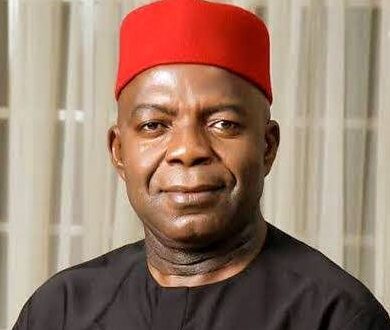
Dr Alex Otti

Greater Ohafia Authority will Promote Inclusion, Integration ~ FENRAD

The Foundation for Environmental Rights Advocacy, and Development, FENRAD, a pro-democracy and environmental rights advocacy group, has commended the Abia State governor, Alex Chioma Otti, on the recent signing of the Greater Ohafia Development Authority.

FENRAD described the legislation as a vehicle to drive development and growth in the Ohafia and Abia North axis spreading to communities in Bende Local Government Area, Isuikwuato and Arochukwu.

In a release signed by its Executive Director, Comrade Nelson Nnanna Nwafor, the foundation recalled that in a bid to map development and ensure efficiency in resource allocation, the old Eastern Region established in the early 1960s the Eastern Nigeria Development Board under whose watch the East became the fastest growing economy and a model.

Nwafor pointed out that “The fact that a similar development authority bill was signed into law by the governor initially shows commitment to building infrastructural projects in the state. And now the same has been done in Abia North with a board set up to monitor implementation.”

He said that with these Governor Alex Otti has shown a desire to accelerate the spread of even development in all parts of Abia, adding that “nothing can be more inclusive than this.”

The FENRAD boss noted that “After Aba and Umuahia, Ohafia ranks next as a major city in Abia State, yet has suffered neglect and abandonment for years. It has been promise after promise with no record to show for it in Ohafia. Yet, the town is vital to unlocking the Abia agricultural potential and boosting productivity in an era when food insecurity has become a nationwide plague.

“Such a development master plan, once in full operation, will improve communication and add more to the value chain lifting many out of poverty. This emphasises how result-oriented a project of this scale could be if well managed.

“The Foundation calls on the state government of the day to ensure that words are matched with actions in the area of critical state infrastructure which is core to rural-urban overlap, spatial and sectoral links. It is only through rapid infrastructure provision that local industries could be fed local raw materials; this underscores how chiefly important this project is.

“Having stated this, the Foundation calls on the Ohafia Local Government Authority to tag along and join the initiative so as to enable development to cascade down to the locals evenly.

“While saluting the state government for this bold initiative, the Foundation urges the government of the day to develop and design a template or master plan that details project phases, and as well to carry out needs assessment so as to ascertain the basic needs of the people in order to narrow gaps in infrastructural needs,” Nwafor said.

Share Post on

Check Also

Make Methane Reduction a Business Priority, NLNG’s Falade urges Gas Industry

... Says Monetisation Initiative Cut Nigeria’s Gas Flaring from 65% to 20%  By Paul Williams   NLNG has urged the global gas industry to make methane reduction a business priority, adding that every tonne of methane released into the atmosphere represents lost revenue and gas that could otherwise reach the market.  The company said its experience shows that investment in reducing these losses can pay for itself while cutting emissions and improving plant efficiency.  Managing Director and Chief Executive Officer of NLNG, Mr Adeleye Falade, made the call at Gastech 2026 Exhibition and Conference in Bangkok during a panel titled “Capturing the Lost Opportunity: Driving Global Alignment on Methane Abatement Across Natural Gas Supply Chains.”  He said the NLNG approach starts with measuring methane losses and using the findings to guide investment in leak prevention and gas recovery, with independent verification to ensure credible reporting.  Falade said the industry needed to shift the conversation from the cost of methane reduction to the value it creates, recognising that preventing gas losses serves both commercial and environmental objectives.  “Every tonne emitted is lost product, lost revenue and lost energy; gas we could have sold. Every molecule of methane avoided is both an emissions reduction and a recovered energy resource,” he said.  He cited NLNG’s new boil-off gas compressor and start-up gas recovery project as examples of investments that support this approach. Each project targets methane reductions of approximately 10–15 per cent, and both have positive projected net present values, meaning their anticipated financial benefits exceed their costs over the life of the projects.  Falade said, “The most compelling business case is the simplest one: the projects that cut our methane also pay for themselves. The same discipline that reduces methane also improves asset reliability and plant efficiency. The returns show up in more places than the emissions ledger.”  He explained that credible measurement underpins NLNG’s investment decisions, which allows the company to identify methane losses, direct resources to the right interventions and assess the results.  He noted that NLNG’s experience demonstrates that gas producers in developing economies can establish globally trusted emissions-reporting systems by investing in monitoring infrastructure, building reporting capabilities and submitting their data to independent scrutiny.  Falade highlighted NLNG’s Gold Standard recognition under the Oil and Gas Methane Partnership (OGMP) 2.0 and said the company was the first in Africa to achieve Level 5 methane emissions reporting.  He added that its measurement, reporting and verification (MRV) system is independently assured by DNV in accordance with ISO 14064.  NLNG’s approach includes site-wide optical gas imaging, a structured Leak Detection and Repair programme, and the phased deployment of continuous monitoring and real-time dashboards across its plant and vessels.  …

Leave a Reply

Your email address will not be published. Required fields are marked *