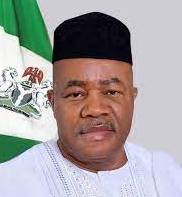
Senator Godswill Akpabio

Enroll Your Children in School or Go to Jail, Senate Warns

By Young E. Freeborn

The Senate has sat for the first reading of a bill that recommends a fine of N50,000 to parents who default in providing their children with primary and secondary school education.

The Red Chamber also recommended free meals for every child in the country.

The bill proposed by Senator Orji Kalu titled, ‘Compulsory free Universal Basic Education Act 2004, Section 2’ states that every government in Nigeria shall provide free, compulsory and universal basic education for every child of primary and junior secondary school age.”

According to the bill, “Every parent shall ensure that his child or ward attends and completes his primary school education and junior secondary school education by endeavouring to send the child to primary and junior secondary schools.

“The Act further states that stakeholders in education in a local government area shall ensure that every parent or person who has the care and custody of a child performs the duty imposed on him under section 2(2) of this Act.”

The bill before the Senate further noted that a parent who contravenes the earlier prescription should be liable, on the first conviction, to be reprimanded.

“On a second conviction, a fine of N2,000 or imprisonment for a term of one month or both; and on subsequent conviction, to a fine of N5,000 or imprisonment for a term of two months or to both,” it said.

The Senate, however, in its amendment, proposed N50,000 fines, instead of the N5,000 previously stated in the Act.

According to the amendment, “Section (4) (b) of the Principal Act is amended by deleting N2,000 and inserting N20,000. Section (4) (c) of the Principal Act is amended by deleting N5,000 and inserting N50,000.”

It added that, “Section 3(2) of the Principal Act is amended by deleting N10,000 and inserting N100,000.

“A person who receives or obtains any fee contrary to the provisions of subsection (1) of this section commits an offence and is liable on conviction to a fine not exceeding N10,000 or imprisonment for a term of three months or to both.

“Every parent shall ensure that his child receives full-time education suitable to his age, ability and aptitude by regular attendance at schools.”

However, the Senate proposes, N100,000 in replacement of the N10,000.

The Senate also proposed, “Section 3(2) of the Principal Act is amended by deleting N10,000 and inserting N100,000.”

Reacting to this development, the programme coordinator for Basic Education at Reform Education, Nigeria, Ayodamola Oluwatoyin, in an interview with newsmen, noted that while the move by the lawmakers seems commendable, there should be an investigation into the additional charges by the public schools across the country.

Share Post on

Check Also

Make Methane Reduction a Business Priority, NLNG’s Falade urges Gas Industry

... Says Monetisation Initiative Cut Nigeria’s Gas Flaring from 65% to 20%  By Paul Williams   NLNG has urged the global gas industry to make methane reduction a business priority, adding that every tonne of methane released into the atmosphere represents lost revenue and gas that could otherwise reach the market.  The company said its experience shows that investment in reducing these losses can pay for itself while cutting emissions and improving plant efficiency.  Managing Director and Chief Executive Officer of NLNG, Mr Adeleye Falade, made the call at Gastech 2026 Exhibition and Conference in Bangkok during a panel titled “Capturing the Lost Opportunity: Driving Global Alignment on Methane Abatement Across Natural Gas Supply Chains.”  He said the NLNG approach starts with measuring methane losses and using the findings to guide investment in leak prevention and gas recovery, with independent verification to ensure credible reporting.  Falade said the industry needed to shift the conversation from the cost of methane reduction to the value it creates, recognising that preventing gas losses serves both commercial and environmental objectives.  “Every tonne emitted is lost product, lost revenue and lost energy; gas we could have sold. Every molecule of methane avoided is both an emissions reduction and a recovered energy resource,” he said.  He cited NLNG’s new boil-off gas compressor and start-up gas recovery project as examples of investments that support this approach. Each project targets methane reductions of approximately 10–15 per cent, and both have positive projected net present values, meaning their anticipated financial benefits exceed their costs over the life of the projects.  Falade said, “The most compelling business case is the simplest one: the projects that cut our methane also pay for themselves. The same discipline that reduces methane also improves asset reliability and plant efficiency. The returns show up in more places than the emissions ledger.”  He explained that credible measurement underpins NLNG’s investment decisions, which allows the company to identify methane losses, direct resources to the right interventions and assess the results.  He noted that NLNG’s experience demonstrates that gas producers in developing economies can establish globally trusted emissions-reporting systems by investing in monitoring infrastructure, building reporting capabilities and submitting their data to independent scrutiny.  Falade highlighted NLNG’s Gold Standard recognition under the Oil and Gas Methane Partnership (OGMP) 2.0 and said the company was the first in Africa to achieve Level 5 methane emissions reporting.  He added that its measurement, reporting and verification (MRV) system is independently assured by DNV in accordance with ISO 14064.  NLNG’s approach includes site-wide optical gas imaging, a structured Leak Detection and Repair programme, and the phased deployment of continuous monitoring and real-time dashboards across its plant and vessels.  …

Leave a Reply

Your email address will not be published. Required fields are marked *