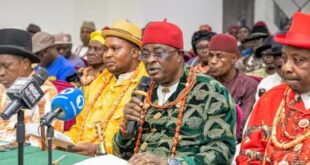
Mr Adamu Michael

Eastern Ports: PM Assures on Waivers, Seeks on Media, Mgt Collaboration

The manager of Rivers Port, Nigerian Ports Authority (NPA), Mr Adamu Michael, has stressed the need for a synergy between the media and port management in Nigeria.

The PM, who hosted a delegation of Energy and Maritime Reporters (EMR) in his office in Port Harcourt on Wednesday, harped on the importance of objective coverage in the reportage of port activities and ease of doing business in the ports, especially the eastern ports of Onne, Warri, Calabar and Port Harcourt.

“We need your support and experience to ensure service delivery to our stakeholders”, he said. “You’re part of the port system and we’ll ensure greater collaboration and relationship that will improve activities in the port.”

He noted that Rivers Port, being in the middle of Port Harcourt, faces several problems which include decayed infrastructure, but added that management was doing its best to ensure that terminal operators played their roles effectively.

He also disclosed that waivers awaited all investors who would do business through the eastern ports, especially those who would export through the terminals, adding that that was part of the steps outlined by the managing director of NPA, Mohammed Bello-Koko, during a stakeholders’ interactive session at the Presidential Hotel in Port Harcourt recently, to stimulate smooth patronage of the eastern ports.

The waivers, he further said, will not be granted only by NPA but also by all other sister agencies operating in the port.

Port Manager, Rivers Port, Mr. Adamu Michael (seated, middle), flanked by Mrs Ezinne Asinobi (PRO) and chairman of Energy and Maritime Reporters (EMR), Martins Giadom, with other members of EMR, during a visit to the Basket House, Port Harcourt

Earlier, chairman of EMR, Mr Martins Giadom, expressed belief that synergy between the port and his group would help the parties in better discharge of their assignments.

He explained that, as specialized beat reporters covering the energy and maritime sectors of the economy of Nigeria, EMR is a communication asset to NPA, the IOC’s, key federal agencies, host communities and other major stakeholders in the sector, especially with regards to information on the ease of doing business in the eastern ports.

He therefore suggested the putting in place of corporate social responsibility programmes in host communities and the organization of seminars and workshops on relevant issues in the sector, as well as facility tours for investors and port operators, as viable ways of sensitizing stakeholders on maritime best practices.

Share Post on

Check Also

Make Methane Reduction a Business Priority, NLNG’s Falade urges Gas Industry

... Says Monetisation Initiative Cut Nigeria’s Gas Flaring from 65% to 20%  By Paul Williams   NLNG has urged the global gas industry to make methane reduction a business priority, adding that every tonne of methane released into the atmosphere represents lost revenue and gas that could otherwise reach the market.  The company said its experience shows that investment in reducing these losses can pay for itself while cutting emissions and improving plant efficiency.  Managing Director and Chief Executive Officer of NLNG, Mr Adeleye Falade, made the call at Gastech 2026 Exhibition and Conference in Bangkok during a panel titled “Capturing the Lost Opportunity: Driving Global Alignment on Methane Abatement Across Natural Gas Supply Chains.”  He said the NLNG approach starts with measuring methane losses and using the findings to guide investment in leak prevention and gas recovery, with independent verification to ensure credible reporting.  Falade said the industry needed to shift the conversation from the cost of methane reduction to the value it creates, recognising that preventing gas losses serves both commercial and environmental objectives.  “Every tonne emitted is lost product, lost revenue and lost energy; gas we could have sold. Every molecule of methane avoided is both an emissions reduction and a recovered energy resource,” he said.  He cited NLNG’s new boil-off gas compressor and start-up gas recovery project as examples of investments that support this approach. Each project targets methane reductions of approximately 10–15 per cent, and both have positive projected net present values, meaning their anticipated financial benefits exceed their costs over the life of the projects.  Falade said, “The most compelling business case is the simplest one: the projects that cut our methane also pay for themselves. The same discipline that reduces methane also improves asset reliability and plant efficiency. The returns show up in more places than the emissions ledger.”  He explained that credible measurement underpins NLNG’s investment decisions, which allows the company to identify methane losses, direct resources to the right interventions and assess the results.  He noted that NLNG’s experience demonstrates that gas producers in developing economies can establish globally trusted emissions-reporting systems by investing in monitoring infrastructure, building reporting capabilities and submitting their data to independent scrutiny.  Falade highlighted NLNG’s Gold Standard recognition under the Oil and Gas Methane Partnership (OGMP) 2.0 and said the company was the first in Africa to achieve Level 5 methane emissions reporting.  He added that its measurement, reporting and verification (MRV) system is independently assured by DNV in accordance with ISO 14064.  NLNG’s approach includes site-wide optical gas imaging, a structured Leak Detection and Repair programme, and the phased deployment of continuous monitoring and real-time dashboards across its plant and vessels.  …

Leave a Reply

Your email address will not be published. Required fields are marked *