 PH Mundial – Port Harcourt Online Newspaper News across the Niger Delta

Related Articles

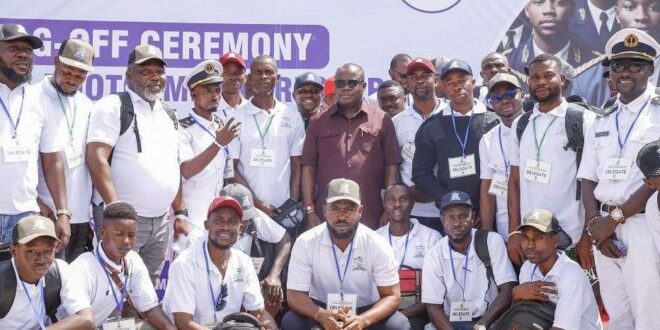
The Presidential Amnesty Programme (PAP) on Wednesday deployed 98 delegates for a boot camp and a refresher course in maritime-related skills as part of its manpower development scheme for the Niger Delta.
Addressing the maritime cadets during the flag-off ceremony at the Joemarine Institute of Nautical Studies and Research, Otomewo, Delta State, the PAP Administrator, Dr Dennis Otuaro, said that manpower and human capacity development were critical to the economic growth of the region and indeed the country.
Otuaro described the deployment of the 98 maritime cadets as strategic and in tune with President Bola Tinubu’s policy on the blue economy to harness the massive opportunities in the country’s maritime industry for national development.
He noted that President Tinubu was interested in manpower development for the nation’s blue economy, stressing that the PAP Office deployed the 98 maritime cadets to train skilled workers for the maritime sector of the economy.
Otuaro, in a press statement signed by his special assistant on Media, Mr Igoniko Oduma, on Thursday, urged the maritime cadets to take their one-month boot camp and refresher training seriously and demonstrate discipline throughout the duration of the programme.
The PAP helmsman said, “I consider this deployment of 98 delegates as strategic because the administration of His Excellency, President Bola Ahmed Tinubu, is very interested in human capacity development for the blue economy. Manpower development is very important to our region and our country.
“Today, we are starting with 98 delegates as maritime cadets for the blue economy. And you all owe us a duty to be committed to your study, and demonstrate that the Niger Delta people are ready to key into the blue economy policy of the President.
“Your moral conduct should be high. See yourselves as ambassadors of the PAP and the region. We will not condone absconding. Obey the regulations of Joemarine. Our eyes are on you. We need good results from you for your communities, the Niger Delta and the President who is very happy over this deployment.”
He, again, thanked the President for giving him the opportunity to serve his Niger Delta people.
Otuaro also expressed confidence in the expertise of the Joemarine Institute of Nautical Studies and Research to carry out the training effectively to achieve the desired objectives.
Earlier in his speech, the PAP’s Head of Vocational Training Unit, Mr. Lambert Daunemighan, had explained that the training was designed by a team of personnel from the Presidential Amnesty Office, South Side International Resources (the consultants) and Joemarine Institute of Nautical Studies and Research.
Daunemighan described the deployment as “a rare achievement by the PAP Administrator”, noting that the aim was to develop world-class maritime professionals for the country’s maritime industry.
The CEO/MD of Joemarine Institute of Nautical Studies and Research, Akpos Epidei, said that the institute had trained over 10,000 maritime professionals from different parts of the country within the past 14 years.
Epidei, who conducted Otuaro and other officials on a facility-tour of the institute, thanked the PAP Administrator for finding them worthy to handle the training of the maritime cadets.
Mr. Ebi Jackson who responded on behalf of those deployed expressed gratitude to the PAP office for giving them a platform to acquire maritime-related skills with potential for meaningful engagement in the maritime space.
In their separate remarks, the Pere of Akugbene-Mein Kingdom and chairman of the institute’s governing council, HRM Pere Luke, as well as the CEO/MD of South Side International Resources, Captain Warredi Enisuoh, commended the PAP Administrator for his policy of continuity.
They also advised the delegates to be worthy ambassadors of the Programme as their good performance would encourage the PAP Office to deploy more Niger Deltans for training to improve the manpower base of the region.