 PH Mundial – Port Harcourt Online Newspaper News across the Niger Delta

Related Articles



By Paul Williams
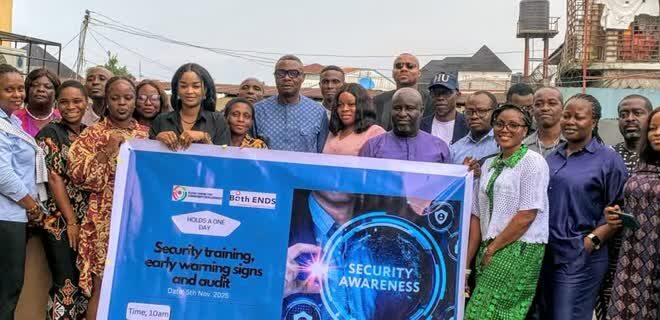
In the face of mounting insecurity in the country, non-governmental organization, OLEGH Centre for Community Development, has organized a one-day training on security awareness and early warning signals for civil society actors, community people and journalists in Rivers State.
The training, tagged Security Training, Early Warning Signs and Audit, organized by OLEGH with support from Both ENDS, held on December 5, 2025 in Port Harcourt, came days after five students of the Rivers State University were abducted by gunmen.
Executive Director of OLEGH, Henry Eferegbo, painted a sad picture of the security situation in the country and state, noting the need to raise the security awareness of civil society actors and journalists whose work constantly place them on the frontlines of “danger and unsecured situations.”
He said, “We conceived the idea of training because of the recent threats that my colleagues and I have received, and because of exposure to certain life-threatening situations in the course of our work. There was also issues of human rights that we have pursued and people who benefit from the system had also gone back and tried to use threats as a form of intimidation against us.
“The second one was because of the new desk we opened in our office early this year where people report issues of sexual and gender-based violence. In an average, I can say we get three, four cases on a daily basis.
“What this means recently, is that between the month of October to now, we have recorded close to 50 rape cases. Over 30 of them have to do with minors – between the age of 12 and 8. And those who raped them, according to information available to us, are usually not less than 40 years old.
“So, when you have this kind of incidents, you need to enlighten yourself and your colleagues on what may likely happen in terms of threats to life, and then become very conscious of security and the environment where we stay. Because when you try to seek justice for this number of people, there is every tendency that one or two persons may not only be comfortable and then will want to think of things to do, or want to use insecurity as a means to ensure that they are not exposed,” he said.
Eferegbo said adverse security situations for the CSOs go beyond threats from perpetuators of gender-based violence, and extends to CSOs who work in the hydrocarbon sector. He cited an instance where he and his colleagues almost lost their lives to hostile elements who were not comfortable with their work at an oil spill site in the state.
He said the need to be security conscious also applies to journalists, while urging them “to please be careful. If you must unravel the facts, you have to be alive to be able to enlighten the public on what is happening around. So, you must take your security seriously, you must be security conscious. It doesn’t matter what fame you want to make.”
Security expert and one of the facilitators at the event, Mr. Victor Umorien, said the training sought to build in participants an “awareness of what you face in your day-to-day activity. As a journalist, you are exposed to a lot of threats. So how can you survive in times of threat to life? How can you get yourself out of it?”
This awareness, he said, requires an understanding of early warning signs in the course of our day-to-day activity, building capacity to understand and interpret the signs, and developing protocols (that is preventive actions) to adopt in situations of insecurity and threat to life.
“The emergency procedures have to be at the tip of your finger. When once you are under any threat or under any attack, the first thing you should do is to make sure you are in a safe place. Then the next thing, you listen to where or watch out for where the threat is coming from. Then lastly, do your contact, that is, call whoever you feel can come for a rescue immediately. Those are the principle of security awareness and awareness of procedures in terms of threat,” he said.
Umorien agreed that journalists “are an endangered species,” adding that “information is very key to development and progress. While going for the evil people, I mean, the criminals, you must know that they will also come for you (journalists) sometime.” He stressed that journalists must raise their security awareness and develop security protocols so as to secure themselves.
“When you do your proper planning, then you can now choose your emergency response contact. So that in case you are being attacked or you are about to be attacked, you raise an alarm. So that these people will come for rescue. When you are planning without an emergency plan, you are not going to be able to do anything. The response might not come at the time you need it,” he advised.
Participants, especially those from oil-bearing communities, such as January Igoma, an indigene of Aminigboko community in Abua/Odual Local Government Area of Rivers State, noted the violence and insecurity that trail the oil and gas industry in the Niger Delta. They expressed gratitude to OLEGH for organizing the training on security awareness, and enabling them to build capacity on emergency response to threatening situations.