 PH Mundial – Port Harcourt Online Newspaper News across the Niger Delta

Related Articles


By Paul Williams
Non-governmental organization, Kebetkache Women Development and Resource Centre has called for accountability and proper assessment of the recent oil spill on the Ogoni area of the state, brought about the rupture of the Trans Niger Pipeline (TNP).
The Trans Niger Pipeline ruptured on May 6, 2025, releasing estimated thousands of barrels of crude, according to Kebetkache, into B-Dere community in Gokana Local Government Area of Rivers State.
Executive director of Kebetkache Women Development and Resource Centre, Dr. Emem Okon, in a release, said the May 6 spill is the second major one in two months and highlights neglect of aging national assets.
She said years of spills have left soil and mangrove forests saturated with hydrocarbons and heavy metals, with 5 –10 % of Nigeria’s mangroves already destroyed by oil contamination and settlement.
According to Dr Okon, “a recent study by Kebetkache showed that communities living near polluted sites have high rates of respiratory ailments, skin lesions, gastrointestinal disorders, and elevated cancer risk due to benzene and polycyclic aromatic hydrocarbons in water and air.
“Oilrelated heavy metals, such as lead and cadmium, bio-accumulates in fish and crops, undermining food security and causing anemia, miscarriages and developmental problems in children.
“While gas flaring, the release of unburned methane and volatile organics, exposes residents to heat stress and endocrinedisrupting toxins, linked to cardiovascular disease and preterm births,” she said.
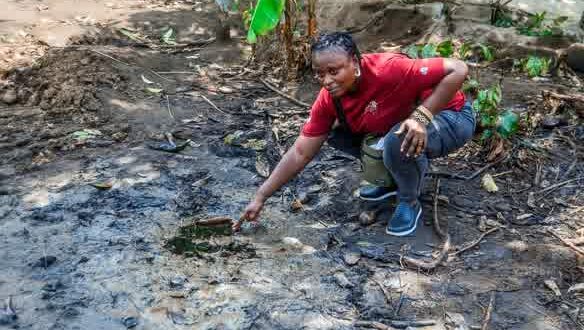
Dr. Okon noted that the rupture on the TNP sent “thousands of barrels of crude oil into residential areas, waterways, and farms in B-Dere community,” adding that “despite halting production on the affected line, cleanup preparations have been slow, and oil continues to skin the community’s land and water sources.
“After engagements with several stakeholders, regulatory agencies and the community it was determined that equipment failure has been cited as the cause of the rupture, underscoring a broader neglect of aging oil infrastructure in Ogoniland.
“This devastation has displaced over a hundred families, which have been forced to leave their homes, seeking refuge elsewhere as crude oil makes living conditions untenable. Loss of Livelihoods have been recorded within the community, as farmlands are saturated with oil, destroying crops and fisheries that sustain local families, especially women who cultivate household gardens.
“The stench of crude oil hangs heavy in the air, creating fire and explosion hazards that make daily cooking impossible; women report respiratory irritation and fear for their children’s safety,” she said.
Dr. Okon pointed out that women in the community, who bear primary responsibility for fetching water, tending family gardens, and feeding their families, have seen their livelihoods destroyed, their health endangered, and their social fabric torn apart.
One of the community women, Mrs. Viga Pius said “For the past 10 days now, we have not been able to cook as we cannot light fire even in our kitchen. Our children and husbands are hungry; we don’t even have good drinking water. Our people are been displaced. We are calling on government, the company and other authorities to come to our aid.”
Another, Tombari Barigbon said “Over 80 hectares of farmlands is affected. Cassava, palm trees and other crops have been destroyed. Families staying within the explosion site have all moved away. The contamination is deep into the farmland, and people will go hungry soon because there will be scarcity of food very soon. Government should make plans for the community.”
Dr Okon further said that on physical assessment of the impacted areas in the community, “we found that the pipeline trench was ‘cocked’ – meaning it was never properly backfilled – and that workers simply pushed loose sand over pooled oil rather than excavating and removing the contamination.
“This practice violates internationally recognized oilspill response standards, which require removal of oiled soil or sorbent materials for safe disposal, not burial in place. Burying oil under sand traps toxic hydrocarbons in the soil, where they continue to leach into groundwater and harm the soil, and it prevents effective downstream remediation and monitoring.
“Despite repeated calls from community leaders and other civil society groups, Renaissance Energy (formerly Shell Nigeria) has not engaged with BDere residents to explain the spill’s cause, share their cleanup plan, or discuss compensation.
“Under Nigeria’s National Oil Spill Contingency Plan, operators are expected to coordinate with local stakeholders and regulatory bodies like NOSDRA, yet Renaissance has neither held town-hall meetings nor provided any livelihood support to displaced families.
“This absence of dialogue deepens distrust and leaves women – who depend on clean water and farmland for their families’ survival – without any clear path to justice or restoration.
“Kebetkache Women Development & Resource Centre visited BDere community to stand in solidarity and now calls on the oil company-Renaissance Africa Energy, government, and regulatory agencies to halt the oil flow, carry out a full cleanup, and compensate families – especially women – for the losses they have suffered.
“We urge all stakeholders to recognize that environmental and human rights are inseparable. The women of BDere demand not only cleanup and compensation but also accountability for the systemic failures that allowed this disaster to unfold.
“We stand ready to work with communities, agencies, and partners to restore BDere’s environment and rebuild livelihoods,” she said.