 PH Mundial – Port Harcourt Online Newspaper News across the Niger Delta

Related Articles

… Make Budgets Gender Sensitive
Local Government authorities in Rivers State have been charged to set up Gender desks for Climate Change Action.
This is aimed at facilitating the implementation of the National Gender Action Plan for Climate Change already put in place by the Federal Government.
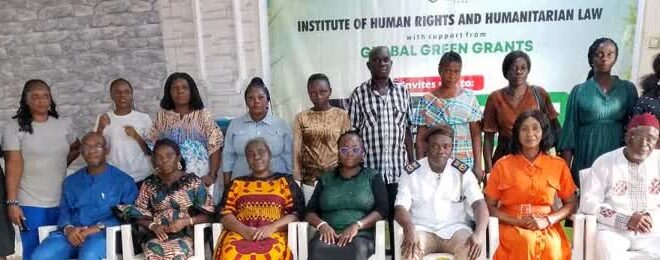
The recommendation was part of others arrived at a capacity building workshop on localizing Gender Action Plan on Climate Change that had local government officials, community leaders and women in attendance.
Executive Director of the Institute of Human Rights and Humanitarian Law (IHRHL), Mrs. Mgbechi Anyakwee, said the workshop was aimed at educating local government officials so that they can implement the plan in their various councils and also ensure that the process is gender sensitive.
She disclosed that the institute implemented a project on promoting knowledge of climate change among girls, women and vulnerable groups to expand the knowledge of climate change.
“We are working with Global Green Grants on localizing gender based action on climate change. We want to adopt National Action Plan in localizing gender action in local government, establishing climate change desk and securing advocacy budget.”
Facilitator of the workshop, Dr. Ameachi Kelechi Justin, stressed that gender can be localized at the local government level, adding that the workshop sought to gauge the level of understanding of the issue among the council leaderships.
“It is to know the capacity of the local government officials and the community people on gender sensitive issues and gender concerns, and align it with National Climate Action Plan to build capacity, conduct institutional assessment on where to ascertain where the government are at the moment and improve on whatever they have”.
Dr. Justin emphasized that there is no action plan on climate change in the 23 local government areas of Rivers State and that is a major point of concern for civil societies and also robs the people of the opportunity to adequately address the challenges of climate change.
“We have been warned on the coming rain by NIMET and other metrological institutions, of imminent flood. If you do not have a policy on adapting and mitigating climate change challenge, how do we begin to take action to mitigate the challenge.
“So there has to be a policy document on how government should address climate change challenges,” he said.
He called on government to end gas flaring, especially in communities where oil and gas activities are ongoing, adding that government can do this by converting gas to energy.
“We are talking about transiting from fossil to green and clean energy; cleaner energy that can harness our gas potential. In fact, studies have proven that we have over 2.09 metric tones of gas.
“We can capture gas that is being flared and convert them to energy to serve the Niger Delta and the country at large.”
The resource person, Chief Constance Meju, who spoke on, ‘Analysis of Gender Roles and Responsibilities in Project Design, Budgeting and Resource Allocation,’ said “it is time to bridge existing gaps in our society to help effectively spread development, so that it will engender accountability and make community rise above poverty and the conflicts they experience.
She said that for centuries, society has determined how people behaved according to their gender, a development that kept women disadvantaged.
“These roles shape our behaviors, attitudes and responsibilities considered appropriate for each gender. This confirms strength and opportunities in the men but has left women in a pool of weakness and deprivation which has created inequality in the society.”
Painting a picture of the status of the ordinary Nigerian woman, Chief Meju pointed out that an international report recently described Nigeria as a dangerous place to give birth.
“A 2023 United Nations report estimated that Nigerian women have the second highest number of maternal deaths in the world; that 1047 women die from every 100,000 deliveries, according to the BBC, and this translates to 75,000 deaths annually”.
Meju added that in Nigeria, women account for over 70 percent of the farming population, but their yield is considered lower because their challenges are neither captured nor addressed in policy circles.
She added that women lack access to quality farming implements, good seedlings, fertilizer, insecticide, technology and right to land ownership.
In 2023, she added, it was estimated that the population of women was around 112.68 million while men were 115.21 million and, women particularly those in the south, are more likely to experience poverty in education, health, employment and living conditions because all are tied to money, and that poverty is strongly linked to gender inequality with women disproportionately facing challenges in assessing resources, opportunities and protection.
Also, the woman in the community is powerless and as such can hardly contribute to development, she said, while calling on lawmakers to engage with women by dialogue to understand their needs and how best to push them forward in governance.
Meju urged public and community leaders to intentionally build women and girls’ needs and considerations into policies and plans, while charging women to follow up on policies and projects meant for them, and also ensure that their voices are heard at all levels of the society to ensure inclusion.
Following the flow of conversations and updates on what is happening to women in other places, some of the chiefs in attendance promised to begin to be gender sensitive in the distribution of resources, opportunities and policy development.
Deputy Director, National Orientation Agency, NOA, Miss Amucheazi ifeyinwa Helen advised people to plant trees which will absorb the gases being emitted to ensure a healthier environment.
She said a solution to the climate change challenge is achieving an inclusive participation through mainstreaming gender.
“Let everybody be involved, especially women and vulnerable groups. Everything concerning women is about rights; if you take away women from anything you’re doing, you have defeated the cause because at the end of the day, you will never achieve as much as you would have achieved if women were involved in the process”.
A participant, Chief Chinedu Nwabueze, from Ibaa Community in Emohua Local Government Areas, said, “I will carry gender action plan to my community; as a grass root people, we will make sure we localize it, As a chief, I have the mouth power to organize my people and recall what has happened today to them.
“In the case of women, we should not discriminate. We should also try to give women equal power for them to participate in all policy making and executions.”
#localize gender climate action plan
#IHRHL-Make Budgets Gender Sensitive