Ogonis in Majority, Most Educated Ethnic Group in Rivers- Akpobari

…Vows no resumption of oil production in Ogoni

‎Niger Delta Environmental Rights Defender, Celestine Akpobari has claimed that the Ogoni ethnic nationality in Rivers State has over the years been subjected to political marginalization in the leadership of the state.

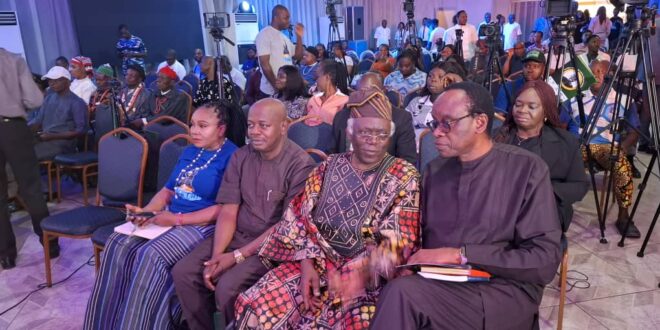
‎Akpobari who spoke to newsmen at the 30th year anniversary event of the death of right activist, Ken Saro Wiwa in Port Harcourt stated that despite its having the majority population and as well the most educated ethnic group in the state, no Ogoni man has been allowed to occupy the position of Governor, Deputy Governor, Chief Judge or Speaker of the state Assembly since the creation of the State.

‎According to the environmentalist, “We must address this marginalization because Ogoni people are the most educated tribe, we are in the majority.

‎”If you remove visitors and strangers in Ikwereland, Ogoni people are in the majority in the state. So why are Ogoni people being marginalized and cannot be Governor, Deputy Governor or Chief Judge of Rivers State,” he said.

‎Akpobari decried a situation where whenever a governor would be selected in the state, the political leaders of the state would bypass Ogoniland and move into Opobo or Andoni, to pick somebody instead of chosing an Ogoni person, stressing that Ogonis are the big brother to both Opobo and Andoni tribes.

‎”This is a conspiracy against Ogoni people. We must look into that because you cannot hate me and like the oil in my land. You are going after the oil in Ogoni but you hate the people of the area that produce the oil,” he explained.

‎The activist who condemned the plans of the President Ahmed Tinubu administration to resume oil explorations in the area, warned that there will be no resumption of oil production in Ogoni land until the government provides solutions to the roots of what led to the initial agitations in the area including the issues of the political marginalization of the area.

‎ Akpobari said the establishment of the Federal University of Environment and other infrastructures in the area would in no way assuage the minds of Ogoni people to allow the resumption of oil production in the land, wondering if Abuja, the Federal Capital Territory (FCT), had any oil deposits in it’s area to have attracted the so much money spent on massive infrastructures in the city.

‎”Over 2000 persons were murdered in Ogoni land. All those that killed our people innocently must be tried, they committed genocide. Resumption of oil will not happen. Ogoni people are not jokers. So they are insulting our people. They are dancing on the grave of our people,” the right activist declared.

Share Post on

Check Also

Disu Proposes Police Desk to Protect Intellectual Property, Creative Economy 

By Paul Williams  Inspector-General of Police, Olatunji Rilwan Disu, has proposed the establishment of an Orange Economy Security and Intellectual Property Coordination Desk within an appropriate existing structure of the Nigeria Police Force.  He made the proposal on Wednesday, September 16, 2026, while delivering a lecture to participants of Senior Executive Course 48, 2026, at the National Institute for Policy and Strategic Studies (NIPSS), Kuru, Plateau State.  The lecture, titled “The Orange Economy and Entrepreneurship for Sustainable Development in Nigeria: The Role of the Nigeria Police Force,” examined the relationship between security, entrepreneurship and the growth of Nigeria’s creative industries.  It emphasised the role of law enforcement in protecting intellectual property, businesses, digital platforms and other assets that support the sector.  Disu noted that film, music, fashion, publishing, advertising, digital content, gaming, tourism, heritage and the arts are increasingly driven by entrepreneurship, technology and intellectual property.  He stressed that these industries can make a stronger contribution to employment, investment and national development when creators, businesses and their intellectual assets are adequately protected.  The IGP, as part of measures to strengthen the Force’s response to crimes affecting the sector, proposed that the envisaged coordination desk should support specialised policing, inter-agency collaboration, dedicated reporting mechanisms and improved engagement with relevant stakeholders.  He further advocated an intelligence-led and partnership-based approach to tackling organised piracy, counterfeiting, cyber-enabled fraud and other criminal activities affecting creative enterprise.  Disu also emphasised the importance of financial investigation, where applicable, in tracing proceeds linked to criminal networks operating through payment accounts, digital wallets, advertising revenues, logistics networks and online distribution channels.  He called for stronger collaboration between the Nigeria Police Force, the Nigerian Copyright Commission and other relevant institutions on intellectual property protection.  He also identified the protection of film locations, concerts, festivals, tourism sites and cultural assets; improved cybercrime response; preservation of digital evidence; and sustained engagement with creative communities as key areas requiring greater attention.  The IGP highlighted the preventive value of legitimate economic opportunities, noting that providing young Nigerians with credible pathways from talent to lawful income and employment can help reduce vulnerability to criminal activity.  He stressed that piracy, fraud, extortion and other forms of criminality can weaken businesses, discourage investment and undermine innovation.  Disu further stressed that effective policing of the sector must protect both public safety and the rights required for creativity and enterprise to thrive, noting that professional, accountable and rights-respecting policing is essential to building confidence among creators, entrepreneurs and investors.  …

Leave a Reply

Your email address will not be published. Required fields are marked *