 PH Mundial – Port Harcourt Online Newspaper News across the Niger Delta

Related Articles



By Onyebuchi Nelson Igbogidi
As the world shifts towards a more sustainable energy future, the integration of renewable energy sources into the grid has become a pressing concern. Renewable energy sources like solar and wind power offer a cleaner alternative to traditional fossil fuels, but their integration into the grid poses significant challenges. In this article, we will explore the challenges and solutions for integrating renewable energy into the grid, ensuring a stable and sustainable energy future.
The integration of renewable energy sources into the grid is not without its challenges. Some of the key challenges include: Renewable energy sources like solar and wind power are intermittent, meaning their output varies depending on weather conditions. This can make it difficult to predict and manage energy supply, leading to grid instability. The intermittency of renewable energy sources is a major challenge for grid operators, as it requires them to balance supply and demand in real-time. Another challenge is the existing grid infrastructure which is often not designed to handle the variable output of renewable energy sources. This can lead to grid congestion, power quality issues, and even grid instability. Finally, the lack of energy storage capabilities can exacerbate the intermittency of renewable energy sources, making it difficult to stabilize the grid during periods of low renewable energy output.
The following diagram illustrates the challenges of renewable energy integration:

Figure 1: Challenges of Renewable Energy Integration
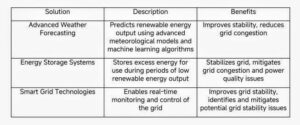
To address the challenges of renewable energy integration which will foster grid stability, several solutions can be employed: Advanced weather forecasting for renewable energy prediction, meaning the key role here is to help predict renewable energy output, enabling grid operators to better manage energy supply and demand. This can be achieved through the use of advanced meteorological models and machine learning algorithms. Another solution is energy storage systems for grid stabilization where energy storage systems like batteries can help stabilize the grid during periods of low renewable energy output. They can also help to mitigate grid congestion and power quality issues. Lastly, smart grid technologies for real-time monitoring and control like advanced metering infrastructure and grid management systems can enable real-time monitoring and control of the grid, helping to identify and mitigate potential grid stability issues.
The following table summarizes the solutions for grid stability:
Table 1: Summary of Solutions for Grid Stability
To ensure successful integration of renewable energy into the grid, several best practices can be employed: Diversifying renewable energy sources can help reduce the intermittency of renewable energy output, improving grid stability. This can be achieved by integrating different types of renewable energy sources, such as solar, wind, and hydroelectric power. Another way to record success is by the upgrading of the grid infrastructure to enable smart grid capabilities improve grid stability and enable real-time monitoring and control of the grid. Finally, implementing energy storage solutions can help stabilize the grid during periods of low renewable energy output. This can be achieved through the use of energy storage systems like batteries.
As a case study, Denmark is a leader in renewable energy integration, with over 40% of its electricity coming from wind power. The country has implemented several solutions to ensure grid stability, including advanced weather forecasting and energy storage systems. Denmark’s experience with renewable energy integration shows that with the right policies and technologies, it is possible to achieve a high level of renewable energy penetration while maintaining grid stability.
The integration of renewable energy sources into the grid is a complex task that requires careful planning and management. By understanding the challenges and solutions for renewable energy integration, grid operators can ensure a stable and sustainable energy future. By employing best practices like diversifying renewable energy sources, implementing energy storage solutions, and upgrading grid infrastructure, we can create a grid that is capable of handling the variable output of renewable energy sources.
Engr. Dr. Onyebuchi Nelson Igbogidi is Senior Lecturer, Department of Electrical and Electronics Engineering, Rivers State University, Port Harcourt.
Email: onyebuchi.igbogidi1@ust.edu.ng