 PH Mundial – Port Harcourt Online Newspaper News across the Niger Delta

Related Articles

By Paul Williams
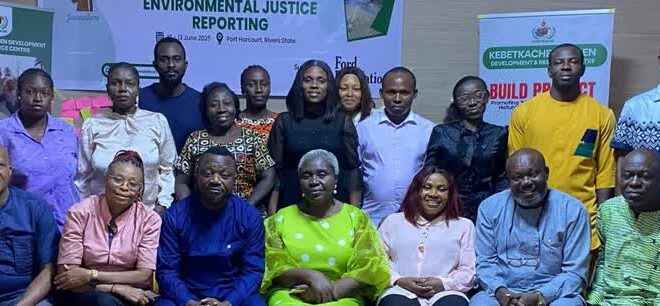
Journalists in the Niger Delta have benefited from a two-day capacity building workshop aimed at equipping them with resources to enhance their reportage of environmental, gender and Nigerian Content issues.
The workshop, tagged ‘Training On Environmental Justice Reporting,’ organised by Kebetkache Women Development and Resource Centre, in collaboration with the Centre for Gender Equity and Sustainable Development, and support from Ford Foundation, ran from June 12 to 13, 2025.
It witnessed the participation of journalists from print, broadcast and Social Media platforms.
Chairman, Center for Environment, Human Rights and Development, and ED, Center for Gender Equity and Sustainable Development, Chief Constance Meju, said “the environment is about our life, and the Niger Delta is the recipient of the climate and environmental issues in the country.”
She pointed out that the region already has issues of environmental degradation, water pollution, kidnapping and the socioeconomic impact of cattle rearers forced down South by heavy desertification in the north.
“The environment is the livelihood of the people, and fishing and farming is our traditional occupations. Those have been destroyed. Which is why we have high youth unemployment, vices and conflict everywhere,” Chief Meju said.
She however pointed out that issues concerning the environment affect women more, “because they are the mothers, they use the environment for their food, for their water, for the care of the family, for their own sanitation.
“Where you have issues of pollution, they are most affected. Where you have climate change issues like flooding, you find that women bear a greater burden, because a man can just take off to a dry land. But the woman cannot leave her family behind, and you can’t carry your children to somebody’s house.
“That is the plight of the Niger Delta women. And flooding and pollution has its own health consequences for the Niger Delta women.
“So we thought it necessary that we keep training and retraining journalists on the issues of the environment. Especially, those of us in the Niger Delta.”
She said that in reporting on issues about environment, it is important that journalists tell the stories so that readers know what the people are going through.
“It means that journalists have to do more than we have been doing. As journalists reporting on environment, we have to understand what the issues are.
“It is by highlighting the effects of these, by going to the people that are affected and letting them speak and even make suggestions about solutions that we can help the policy makers to make correct policies,” Meju said.
Executive Director of Kebetkache Women Development and Resource Centre, Dr. Emem Okon, noted the importance of mainstreaming gender in environmental reporting.
Dr Okon, who had earlier delivered a paper on ‘Environment and the Challenges of the Niger Delta,’ stressed that by mainstreaming gender in their reports, journalists are inadvertently “promoting sustainable development.
“Because this will keep reminding those in authority, at the local government, chiefs, kings, even at the state level, that development should not be planned as a gender neutral affair, but that the interest of everybody should be included.”
Dr. Okon noted that journalists need to mainstream gender particularly when reporting the pollution, oil extraction and environmental degradation in the Niger Delta, as well as issues surrounding Petroleum Industry Act, local content Act and Host community development trusts (HCDTs).
“When we are talking about the PIA and the host community development trust you begin to look at issues of how many women are in the board and management of the trusts? What powers do women have in the trust? The NEEDS assessment. How were community women involved in the NEEDS assessment?
“Not just community women, but the youths also. And when we talk about youths, female youths. How were persons with disability involved in the needs assessment? Were their needs identified? Are their needs included in the community development plans?
“If you do that, you must have created awareness and also directly or indirectly educate the leadership of the trust on how they should manage the trust,” Dr Okon said.
A participant at the workshop, Susan Serekara-Nwikhana, said “the training has been so impactful. I want to commend Kebetkache for putting up such a two-day training program on environmental justice reporting for journalists.
“I’m so interested because for journalists, it means that they saw the need for us to be properly sensitized, to be properly informed about how environmental issues should be reported in the society.
“As an individual, I have benefited a lot. One, it (training) has broadened my scope. There is a lot of take-home I have already noted. And I know that with us emphasizing more and more on this environmental reporting, the environment will be made favorable for all of us to live in,” she said.
Papers delivered at the workshop include: ‘Environment and the Niger Delta Challenge’ by Dr. Emem Okon, ‘UN Guidelines on Business and Human Rights’ by Stephen Obodokwe, ‘Enviromental Reporting’ by Chief Constance Meju, ‘Understanding PIA and LCA’ by Engr Henry Eferegbo, ‘Reporting Sexual Rights and Gender-Based Violence’ by Comrade Tombari Dumka-Kote and ‘Gender Mainstreaming and Inclusion’ by Chief Constance Meju.