 PH Mundial – Port Harcourt Online Newspaper News across the Niger Delta

Related Articles



By Paul Williams
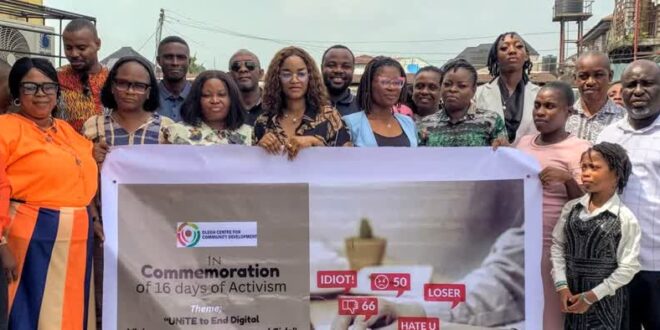
As part of activities marking 16 Days of Activism, non-governmental organisation, OLEGH has organised a one-day awareness creation workshop, on digital violence against women and girls, for civil society and media groups in Rivers State.
The event, which was organised with support from Both ENDS, held in Port Harcourt on Wednesday December 10, 2025.
OLEGH’s Executive Director, Henry Eferegbo, said the programme was “intended to draw attention to the theme for this year’s 16 Days of Activism, which is, ‘Unite to End Digital Violence against all Women and Girls.’
He said the 16 Days of Activism, which is an annual global campaign that focuses on violence against women, affords persons and groups all over the world the opportunity to embark on activities aimed at eliminating all forms of women and gender abuse.
Eferegbo pointed out that, “As individuals, we don’t pay attention to the things we see on the social media. We pay less attention to the abuse on the internet. Today, you can abuse a woman or a man physically, emotionally and otherwise, and go scot-free.”
OLEGH’s Executive director said women and girls have suffered the most from online violence and cyber-bullying, particularly on platforms such as TikTok, making them ready victims online and offline.
“So, in line with the United Nations principle on 16 Days of Activism and this year’s theme, there is a need for OLEGH Center to create awareness on issues resulting from the online abuse of women and girls. We decided to bring in a resource person who will tell us how to avoid being abused online.
“Also, when you are abused, what you can and should do. Will you keep quiet when abused? Or do you have to take a step as a form of solution to reducing such abuse,” he said.
He urged participants at the awareness creation programme, which included civil society actors and media persons, “to see how we can put hands together to rise up and speak against digital violence online.”
Eferegbo added that OLEGH is working towards creating an online help-desk for victims of online abuse and digital violence.
He further urged participants to improve their security awareness while online, and adopt security protocols that would protect them in the digital space.
Resource person, Jacob Iniodu, in a paper titled, ‘Understanding Digital Abuse within the 16 Days of Activism,’ listed forms of online violence to include, cyber-bullying, dozing, cyber-stalking, invasion of privacy, among others.
He said though the Federal Government, through the Nigeria Data Protection Act (NDPA), has created legal frameworks for protection of citizens’ digital rights and privacy, “it is relevant for us as Nigerians, to protect ourselves from the dangers online.”
Iniodu explained that, “Digital violence or digital abuse is the use of technology, such as phones, social media, anything to harass, state, intimidate, control someone, especially women.”
Examples of these, he said, include, cyberbullying and trolling, online stalking, tracking location of someone, sharing on private photos without consent, hate speech, doxing, and impersonation.”
Iniodu pointed out that, “violence around online space often migrates to violence offline. There’s a global statistic that says one in three women faces gender abuse.”
He added that with a growing internet penetration in Nigeria, estimated at over 150 million internet users, and existing gender inequality in the country, the situation is more alarming for women and girls.
Digital violence, Iniodu said, “matters profoundly in Nigeria, because it is not only inflicting immediate psychological, social and economic harm, but it also hinders national development, spreads gender gaps and worsens vulnerability in an already challenging region.”
Cynthia Okuh, Program Officer, Together to Win for the Deprived (T2W) and volunteer for the Rivers State Response Team on Violence Against Women and Children, said violence against women and girls is no longer only physical.
“Today, cannot only be abused or violated physically, there is digital violence. Digital abuse is a thing. And it’s rampant today. You see people online, they abuse each other, they do a lot of things to degrade each other. To make people feel so less of themselves.
“At the end of the day, you find out that the impacts are not good. Sometimes people are depressed. People feel less of themselves. People feel that, okay, do I even have a reason to live? Because of the way another has spoken to them.
“And these (the bullies) may be people they do not even know. Most times these are people you do not know. People that have no connection with you,” she said.
Okuh commended OLEGH for creating the platform for CSOs to examine these issues, and for participants to learn how to protect themselves online and curb such abused.